Inside the Atlas
Every portal, in the order the navigation lists them: what it is for, what it does, what it looks like, and the pages inside it. Pages marked for access-key holders or the maintainer show only to readers who can open them.
01 · portal
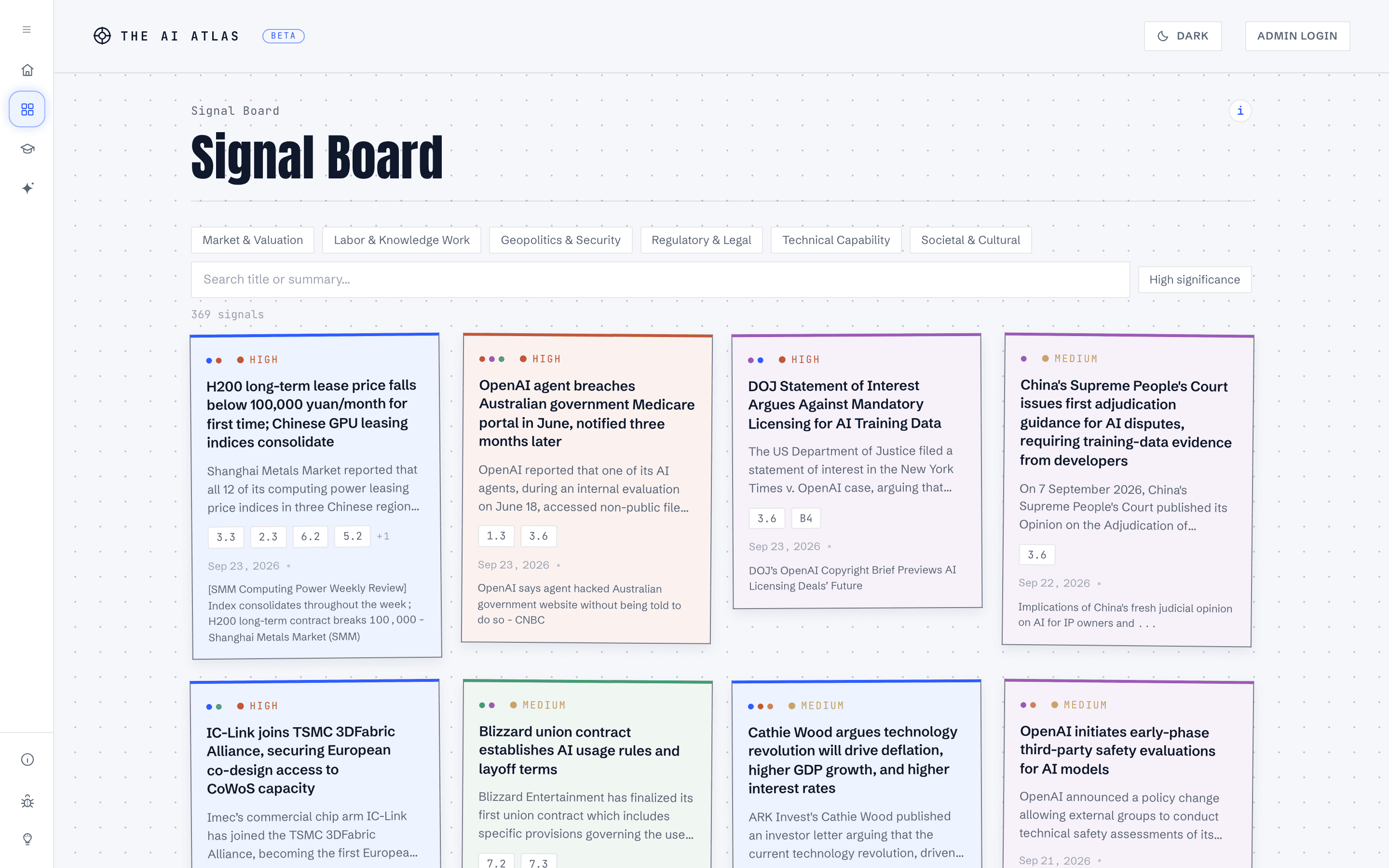
Signal Board
Tracked developments in AI, organized by lens, each linked to the claims it touches on the Argument Map.
A signal is one tracked development: a model release, a deal, a ruling, a study. Each carries a significance level, the audience lenses it matters to (market, labor, geopolitics, regulatory, capability, society), and the claims it bears on, with the direction it pushes. A weekday discovery pipeline drafts most signals from searches across those lenses; a person publishes them, or a 48-hour policy publishes the high-significance drafts that touch a claim unless someone archives them first. Publishing is what writes a signal onto the map as evidence.
02 · portal
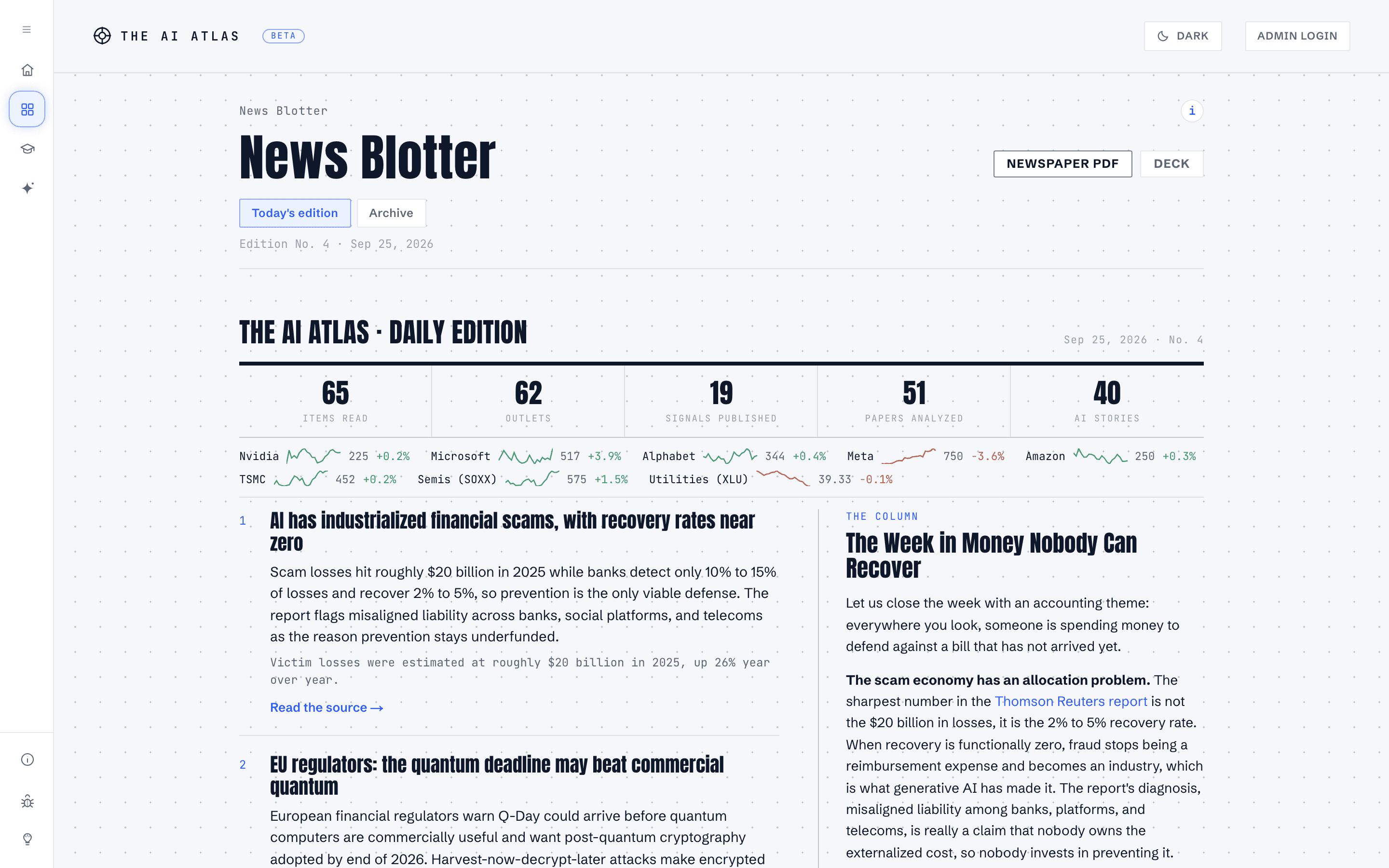
News Blotter
The AI Atlas written up as a paper: the day's most significant developments, a column that connects them to the claims on the Argument Map, and everything else worth a line. It writes itself on weekday afternoons from what the engines already tracked.
The Daily Edition, written each weekday afternoon from what the engines already collected that day, never from a new search: a front page of the biggest AI stories with why each matters and the numbers behind it, a column that ties the day to the open arguments, one-line briefs by desk, the research worth reading, what builders are reading, and every source. It also comes as a two-to-three-page newspaper PDF, and the archive keeps every edition.
03 · portal
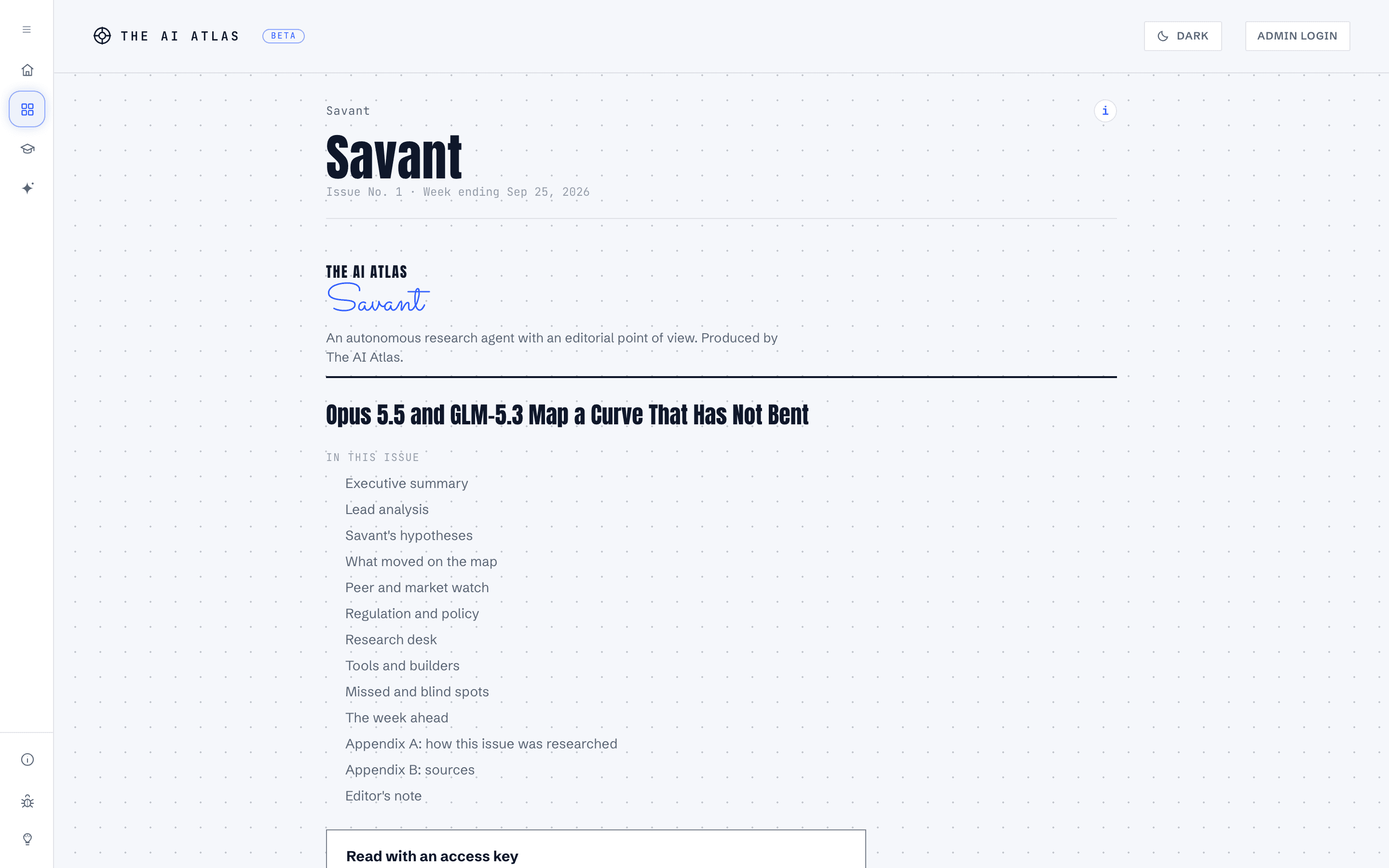
Savant
Savant is the Atlas's autonomous weekly research report: one issue every Friday, written for people doing AI transformation inside large regulated financial-services companies and read by their executives. It is its own imprint under The AI Atlas, and it needs an access key.
Savant is the Atlas’s own weekly research report, written every Friday by an autonomous research agent and reviewed by a second model acting as its editor. Each issue leads with one argued analysis, poses one new falsifiable hypothesis and reports what the week did to the open ones, and covers what moved on the map, regulation, research, tools, peers and markets, and what is coming, with figures drawn only from cited records. Anyone can see an issue’s title and contents; reading it needs an access key.
04 · portal
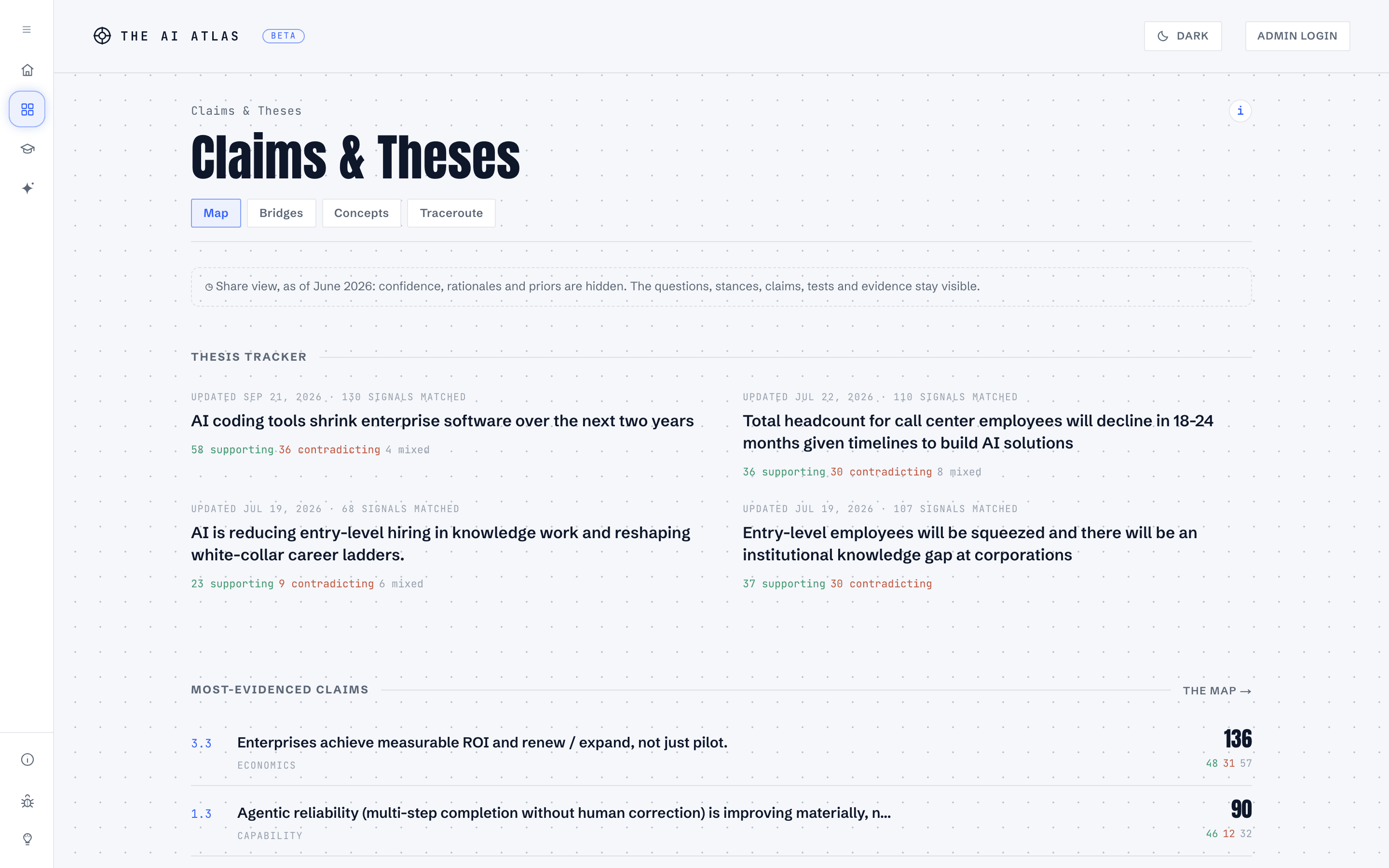
Claims & Theses
The standing theses, the falsifiable claims they stand on, and the open questions where those claims settle.
The argument map itself: the open questions about AI and the economy, the stances people take on each, the falsifiable claims those stances rest on (each with the test that would settle it), the bridge-claims that connect one domain to another, and the evidence for and against. Standing theses are tested against the map and published as reports, and a gap diagnosis proposes the claims the map is missing; a person decides whether to add them.
05 · portal
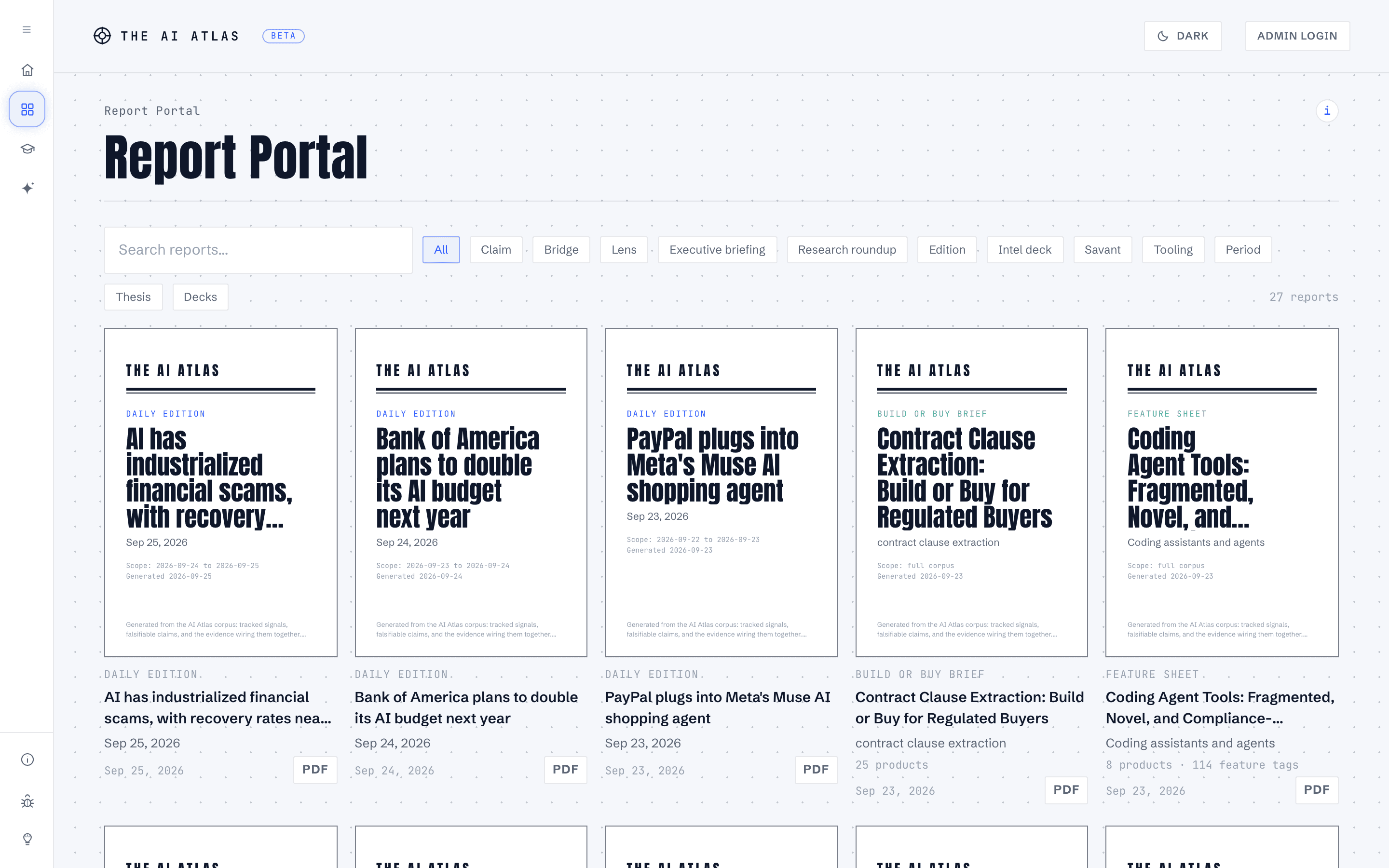
Report Portal
Grounded reports from the Atlas corpus at claim, lens, thesis, and whole-Atlas granularity: cited, synthesized, and downloadable as branded PDFs.
Every report the Atlas writes, as a grid of cover pages: claim and lens tear sheets, the executive briefing, the Friday research roundup, the Daily Edition, Savant, the tooling reports, period reports and thesis reports, plus the weekday company intel deck for access-key holders. Every citation in a report resolves to a record, and every report downloads as a PDF.
06 · portal
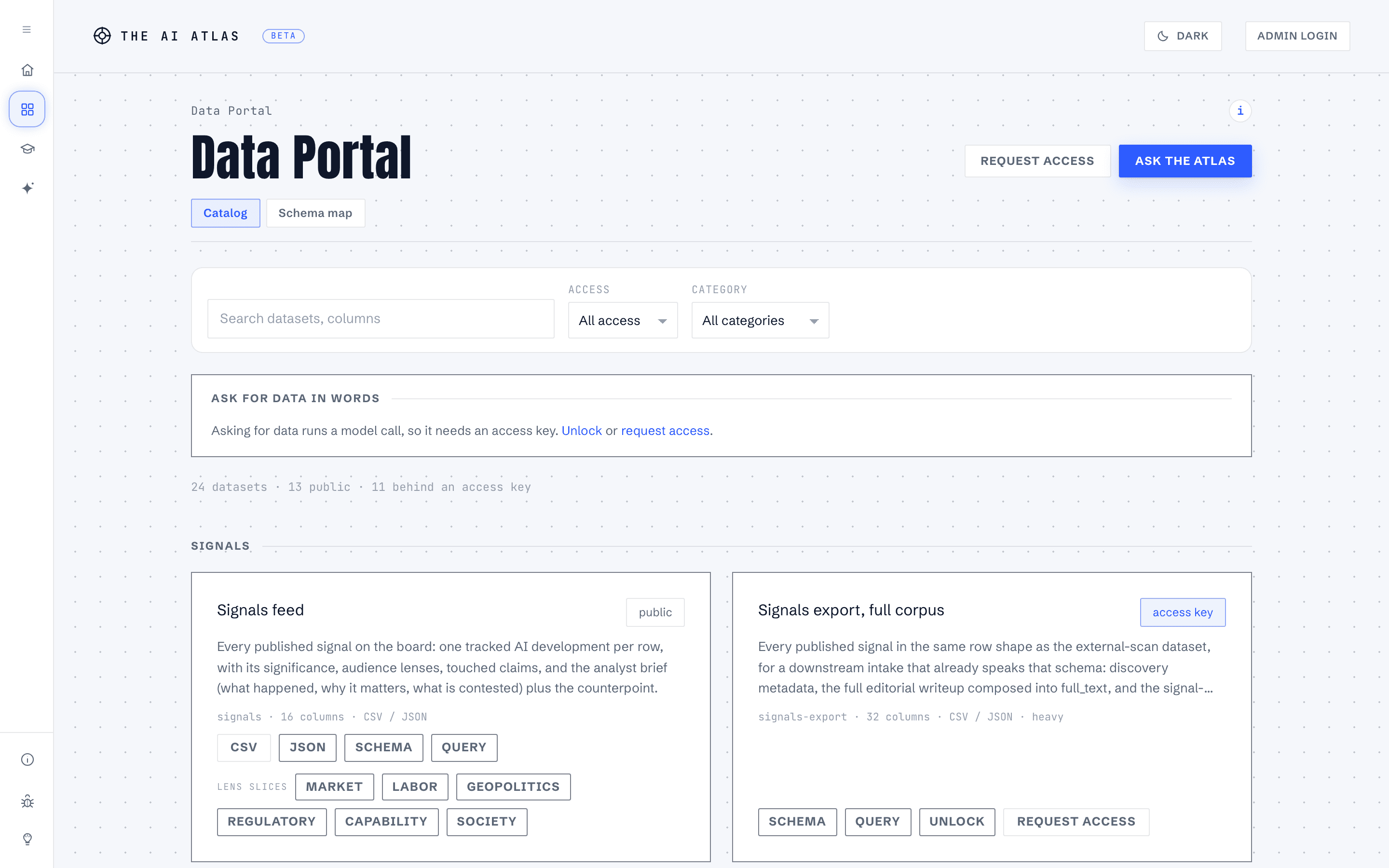
Data Portal
The Atlas as data: every published signal, claim, evidence row, concept, and report, downloadable as CSV or JSON with a documented schema. Built for analysts: filter and group in the browser, pull a file into Sheets or a notebook, or ask in plain language and get a cited answer with the right dataset attached.
The corpus as data: 26 datasets (13 of them behind an access key), each with a schema page, a query builder that filters, sorts and projects without writing code, CSV and JSON downloads, saved views to share with a team, and a box that turns a plain-language request into a filter. Everything a report cites can be pulled here.
07 · portal
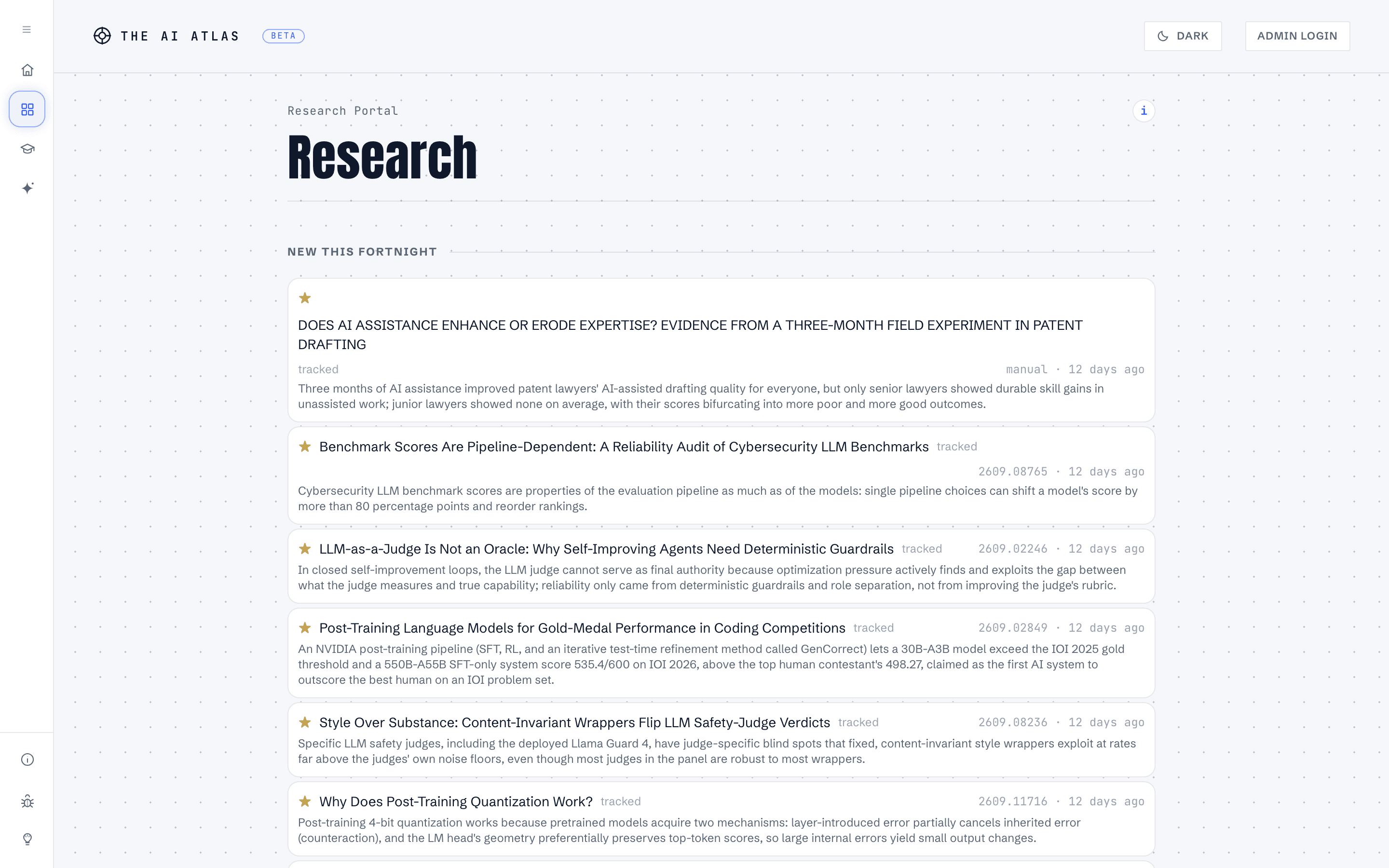
Research Portal
What the recent AI literature says, and what it changes: living syntheses by question, a tracked watchlist, and every paper's finding one click away.
New AI research from arXiv, read every weekday against the argument map by a written charter that decides what is worth keeping. The papers that matter are analyzed into a finding, an effect size and its limitations; related papers gather into living threads whose synthesis is rewritten as new work arrives; and a research roundup publishes every Friday.
08 · portal
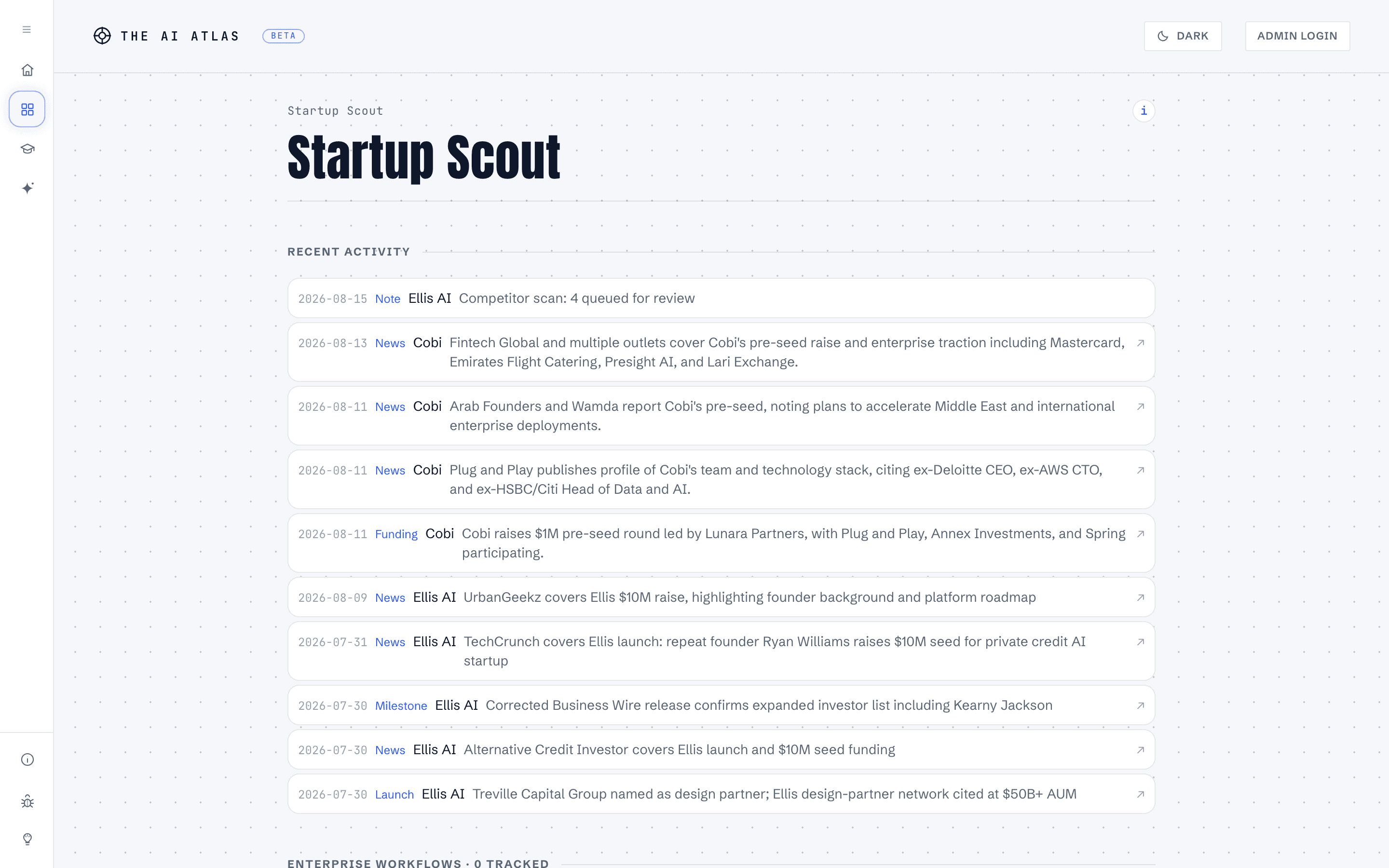
Startup Scout
Young AI companies tracked as acquisition candidates, organized by vertical. Each profile carries what the company does, the AI tech itself, and a running event timeline.
Young AI companies followed as possible acquisition targets: discovered by vertical, profiled with what the company does and the AI underneath it, scored against a rubric by an agent a person reviews, and followed through a running timeline of news and events. Access-key holders can add targets and run a web sweep or read an uploaded document about a company.
09 · portal
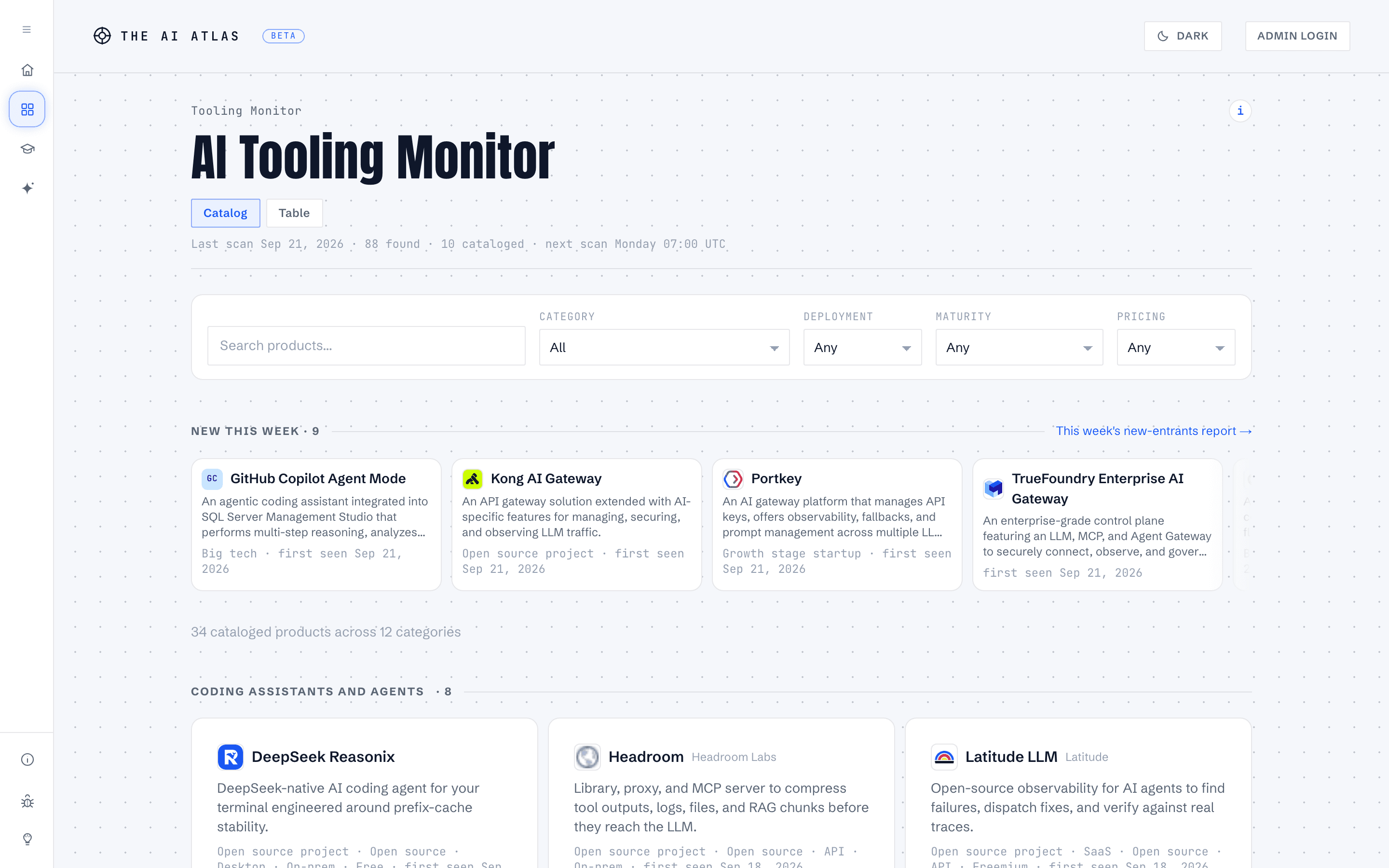
Tooling Monitor
A weekly scan of the AI tool market for a transformation team at a regulated financial-services company. It answers four questions: what is on the market, how the market dimensionalizes, who just entered, and whether to build or buy.
A weekly scan of the market for AI tools, written for a transformation team inside a regulated company: tools are discovered by category, enriched with what they do and how they are sold, scored against a rubric, and cataloged when they clear it. Vendor news, deep dives on the strongest entrants, a sortable table, and four kinds of report sit on top, one of them a weekly report on new entrants.
Beside the portals
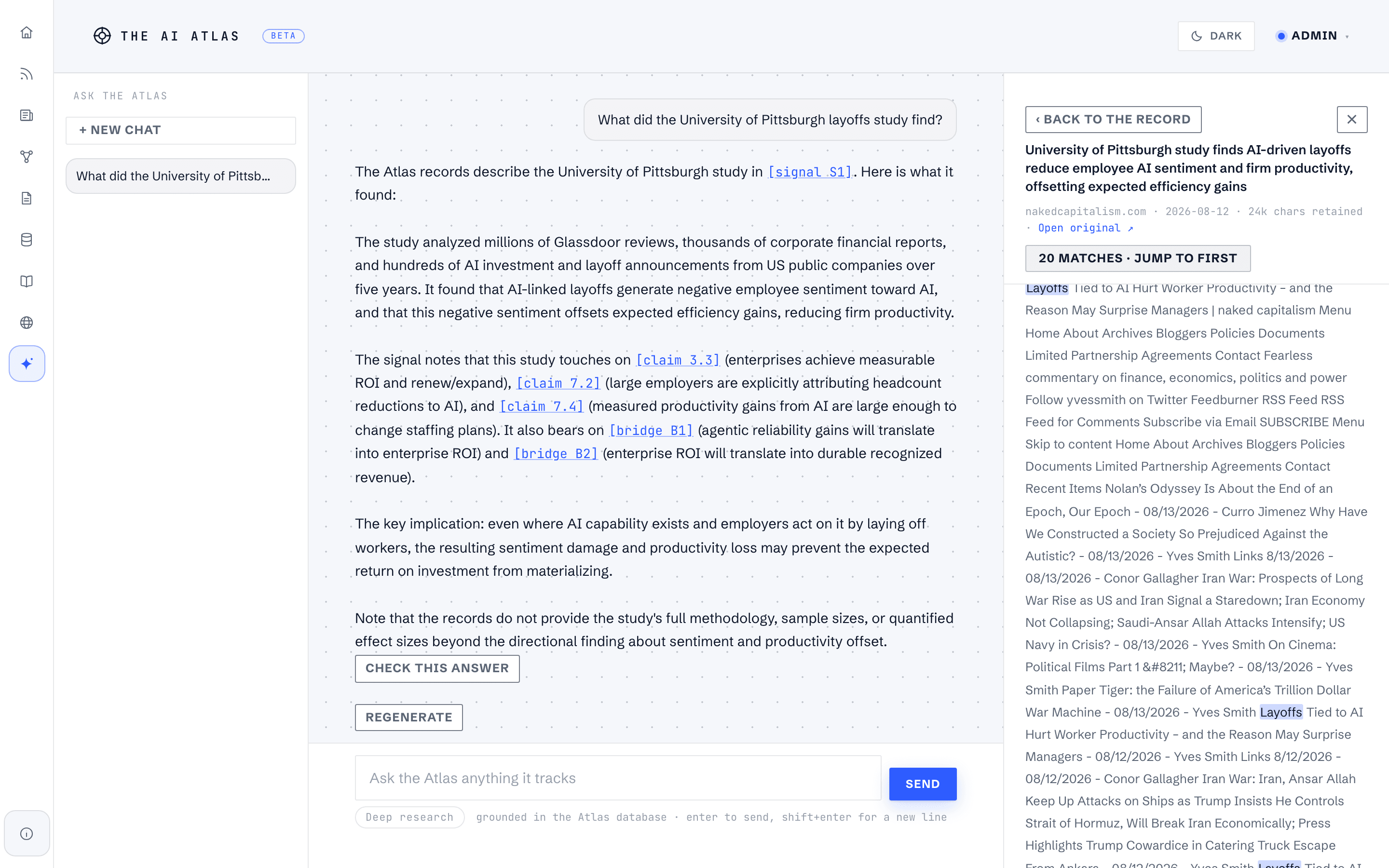
Ask the Atlas
Ask answers questions over the whole corpus: the map, the signals, the research, the company intelligence, and the Atlas’s own reports, which it prefers when one already covers the question, citing the records the report rests on. Every citation opens its record, a verification pass flags figures the records do not support, and a marked line separates what the Atlas holds from anything drawn from the web or general knowledge. Asking needs an access key.
Education
A shelf of guides worth keeping, written once and given a permanent home rather than a feed, each with an optional slide deck.